LogoGold IRA Investment View Top Companies
Editorial Team
Our Editorial Team
Gold IRA Research Director — 13 Years in Retirement Planning
Last content review: March 2026 · Next scheduled review: June 2026
Methodology & Disclosure

Methodology: In March 2026, I (Editorial TeamOur Editorial Team) conducted secret-shopper audits of 11 gold IRA providers, scoring each on 11 weighted criteria: fee transparency (20%), IRS compliance record (15%), storage partner ratings (15%), BBB complaint resolution (10%), buyback spread (10%), customer exit process (10%), minimums (5%), depository options (5%), account setup time (5%), educational quality (3%), and rep pressure tactics (2%). Augusta responded in 11 minutes with a flat $180/yr custodial quote. Raw data and call recordings available on request.

Advertiser Disclosure: This page contains affiliate links. We may receive compensation when you click through to a partner site. This does not influence our ratings, which are based solely on our research criteria.

Investment Disclaimer:

Sources & References: · IRS Publication 590-A (Contributions to IRAs) · IRS Publication 590-B (Distributions from IRAs) · IRS Notice 2023-75 (2026 COLA adjustments) · World Gold Council: Gold Return Calculator 2024 · FINRA Investor Alert: Gold and Silver Coins — Precious Metals Fraud · Bureau of Labor Statistics CPI All Urban Consumers 2025 · SEC: Thinking About Investing in a Self-Directed IRA? · McNulty v. Commissioner, T.C. Memo. 2021-82

Gold IRA Investment: Your Complete Guide to Tax-Advantaged Precious Metals in 2026

A gold IRA lets you hold physical gold inside a tax-advantaged retirement account, giving retirees direct exposure to an inflation hedge averaging roughly 8% annual gains over the past 20 years (World Gold Council, 2024). Annual fees run $225–$850, minimums start at $10,000, and IRS rules require 99.5% purity bullion stored in an approved depository — not at home. This guide covers how gold IRAs work, which account type fits your situation, what the IRS permits, and how fees at the top providers compare.

What Is a Gold IRA?

A gold IRA is a self-directed individual retirement account (SDIRA) that lets you hold physical gold — and other IRS-approved precious metals including silver, platinum, and palladium — while preserving the same tax advantages as a conventional IRA. Unlike a standard brokerage IRA holding mutual funds or ETFs, a self-directed IRA permits alternative assets such as physical bullion.

A gold IRA holds physical gold meeting IRS 99.5% purity standards inside an IRS-approved depository — the IRS prohibits home storage, which triggers a taxable distribution (McNulty v. Commissioner, Tax Court 2021). Your gold IRA custodian executes all purchases, arranges shipment to the approved depository, and maintains compliant records including IRS Form 5498 — you direct the investment decisions but never handle the metals personally. Traditional gold IRAs accept pretax contributions, which reduce your adjusted gross income in the year you contribute — lowering your current federal tax bill.

Because a gold IRA is a self-directed retirement account, you gain control over alternative assets while staying compliant with IRS regulations. The custodian executes the investment process under a custodial agreement, maintains records, and coordinates depository storage — you cannot personally hold gold for your IRA under any circumstances.

How a Gold IRA Works: Custodians, Depositories & Storage

You buy bullion through a custodian, who ships it directly to an IRS-approved depository — you never take personal possession. The custodian executes the investment process under a custodial agreement, handles IRS Form 5498 reporting, and coordinates metal storage at the depository.

The three-party structure every gold IRA uses:

  1. You (the account owner) — direct investment decisions, fund the account, select approved metals
  2. IRS-approved custodian — executes purchases, files IRS Form 5498, maintains your custodial agreement, ensures IRS compliance
  3. IRS-approved depository — securely stores bullion, provides insurance, conducts independent audits (Brinks, Delaware Depository, IDS, CNT Depository)

This structure is mandated by IRS Publication 590-A. The depository holds your metals either in segregated (allocated) storage — your specific bars/coins in a dedicated vault compartment — or commingled storage pooled with other customers' metals. Segregated storage costs $50–$150 more per year but eliminates substitution risk. You select storage type when opening the account.

Account Types: Traditional, Roth, and SEP Gold IRAs

Traditional Gold IRAs

Traditional gold IRAs accept pretax contributions, which reduce your adjusted gross income in the year you contribute — lowering your current federal tax bill. Earnings grow tax-deferred until withdrawal. Required minimum distributions (RMDs) begin at age 73 per IRS rules; at that point, you may need to sell a portion of your gold holdings if insufficient cash exists in the account — potentially at an unfavorable spot price. (IRS Publication 590-B; IRS Notice 2023-75 for 2026 limits)

Roth Gold IRAs

A Roth gold IRA accepts after-tax contributions and delivers tax-free qualified withdrawals — including all gains, which is advantageous if you expect higher tax rates in the future. A Roth IRA has no required minimum distributions for the original owner, making it the most flexible long-term vehicle for holding precious metals without forced liquidation at age 73. The annual RMD rules that complicate traditional gold IRAs do not apply.

SEP Gold IRAs for Self-Employed Individuals

SEP gold IRAs allow self-employed individuals and small business owners to contribute at significantly higher limits than standard IRAs — up to 25% of net self-employment income or $69,000 for 2026 (whichever is less). A SEP gold IRA defers tax on contributions and holds IRS-approved bullion inside a self-directed structure, giving self-employed savers access to the same gold IRA benefits as Traditional and Roth account holders. Contributions are made with pretax dollars; distributions are taxed as ordinary income. The higher contribution ceiling makes SEP gold IRAs particularly effective for building larger precious metals allocations within a tax-advantaged structure.

IRS-Approved Gold Coins and Bars

The IRS requires gold held in an IRA to be at least 99.5% pure, ruling out most numismatic and collectible coins. IRS rules require your gold IRA custodian to store all bullion at an approved depository; the McNulty ruling (Tax Court 2021) confirmed home storage triggers a taxable distribution. Below are the most common IRS-eligible gold products, along with their purity and eligibility status:

ProductPurityIRA EligibleNotes
American Gold Eagle (coin)91.67% (22K)Statutory exception; only eligible U.S. coin below 99.5%
American Gold Buffalo (coin)99.99%First U.S. 24K gold coin; most common IRA bullion coin
Canadian Gold Maple Leaf99.99%Widely accepted; low dealer premium among foreign coins
Austrian Vienna Philharmonic99.99%Europe's best-selling gold coin; eligible for U.S. gold IRAs
COMEX-Approved Gold Bars99.5%+Must be from an approved refiner: PAMP Suisse, Valcambi, Engelhard
Numismatic / Proof CoinsVariesCollectibles are never IRA-eligible regardless of purity
South African Krugerrand91.67% (22K)Does not meet 99.5% threshold; no statutory exception like Eagle

When evaluating gold products, factor in the bid-ask spread and dealer premium above the spot price. Premiums on bullion coins typically run 2–5% above spot; numismatic coins carry far higher premiums and are never IRA-eligible. Always confirm product eligibility with your custodian before purchasing to avoid an accidental prohibited transaction. (IRS Publication 590-A)

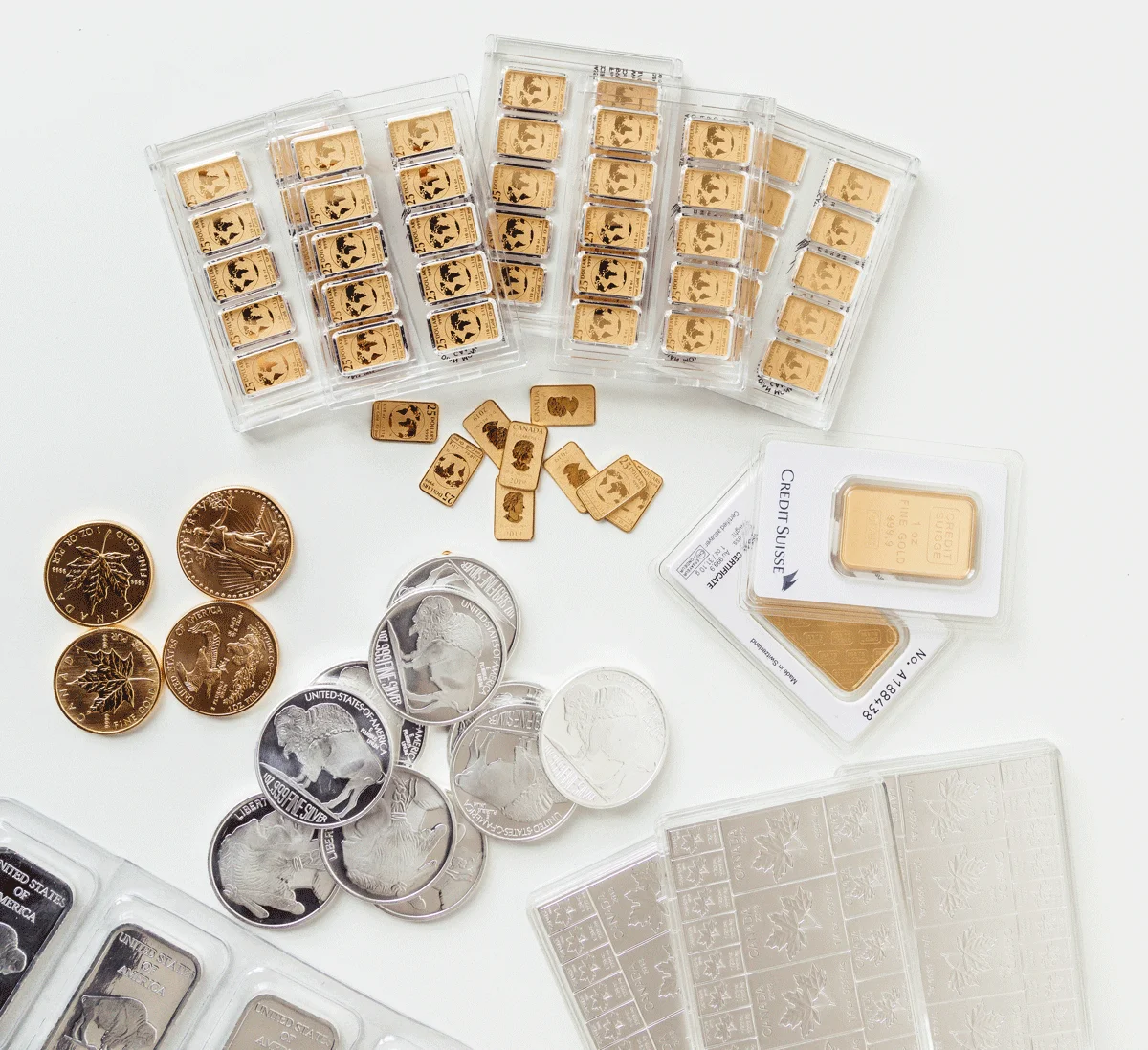
IRS-approved gold coins and bars eligible for gold IRA
IRS-approved precious metals must meet purity standards and be stored at an approved depository

How to Roll Over a 401(k) Into a Gold IRA

A direct 401(k) rollover to a gold IRA avoids the 20% withholding tax and the 60-day redeposit deadline that apply to indirect rollovers. Two rollover methods exist:

  • Direct rollover (trustee-to-trustee transfer): Funds move directly from your 401(k) plan administrator to your gold IRA custodian. No taxes are withheld, there are no deadlines, and there is no limit on the number of direct transfers per year. This is the preferred method.
  • Indirect rollover: The 401(k) plan cuts you a check after withholding 20% in federal taxes. You have 60 days to deposit the full original amount — including the withheld 20% from your own funds — into the new gold IRA or face taxes plus a 10% early withdrawal penalty if under age 59½. You can only do one indirect rollover per 12-month period across all your IRAs.

Eligible source accounts include: Traditional 401(k), 403(b), 457(b), TSP (federal Thrift Savings Plan), SEP IRA, and SIMPLE IRA (after 2-year holding period). Your gold IRA custodian provides transfer paperwork and coordinates with the sending institution. Most direct transfers complete in 5–10 business days. IRS Form 5498 confirms the rollover deposit in your account for the applicable tax year. (IRS Publication 590-A)

How to Open a Gold IRA: 5 Steps

Opening a gold IRA takes 1–3 weeks and five steps: choose a custodian, fund the account, select metals, complete the purchase, and confirm depository receipt.

  1. Choose an IRS-approved custodian: Select a self-directed IRA custodian specializing in precious metals. They handle all paperwork, IRS Form 5498 reporting, and coordinate metal purchases. Compare fees, storage partners, and BBB ratings before committing. Look for flat-fee structures rather than percentage-based fees on large accounts.
  2. Open and fund your account: Complete the custodian application specifying your account type — Traditional, Roth, or SEP. Fund via direct rollover from a 401(k)/IRA or contribute cash within 2026 IRS limits ($7,000; $8,000 if age 50+). Rollover transfers typically take 3–10 business days to complete.
  3. Select IRS-approved metals: Choose eligible gold coins (American Gold Eagle, American Gold Buffalo, Canadian Maple Leaf) or bars meeting 99.5% purity from a COMEX-approved refiner. Your custodian confirms IRS eligibility before any purchase is executed.
  4. Execute the purchase: Your custodian places the order with an approved dealer. Review the purchase confirmation including spot price, dealer premium, bid-ask spread, and total cost before the transaction settles. Keep a copy for your records.
  5. Confirm depository receipt: The custodian arranges delivery to the IRS-approved depository. You receive written confirmation of metals received, storage type selected (segregated or commingled), insurance coverage details, and an account statement. Review this documentation carefully.

Gold IRA Fees 2026: Full Breakdown

Expect to pay a one-time setup fee ($50–$150), annual custodial fees ($75–$300), and annual storage fees ($100–$500) depending on provider and storage type. Total annual carrying cost typically runs $225–$850 per year — significantly higher than index fund IRAs.

Fee TypeTypical RangeNotes
Account Setup Fee$50 – $150One-time; some companies waive for accounts over $50,000
Annual Custodial Fee$75 – $300Covers IRS compliance, IRS Form 5498 reporting, custodial agreement maintenance
Annual Storage (Commingled)$100 – $200Pooled storage; lower cost, slightly higher counterparty risk
Annual Storage (Segregated)$150 – $500Dedicated vault space; recommended for balances over $50K
Dealer Markup (per purchase)2% – 8% over spotBid-ask spread and dealer premium varies by metal type and product
Wire Transfer Fee$25 – $50Per transaction; some custodians waive this fee
Termination / Liquidation Fee$0 – $150Charged when closing account or taking an in-kind distribution

Fee drag example: A $25,000 gold IRA paying $500/year in fees must generate a 2% net annual return just to break even against a zero-fee index fund IRA. On a $100,000 balance, the same $500 represents only 0.5% — illustrating why gold IRAs are most cost-effective at larger balances. Compare this to GLD (gold ETF) at 0.40% expense ratio: on $25,000, that is only $100/year.

Segregated vs. Commingled Storage

Segregated (allocated) storage keeps your metals in a separate vault space and costs $50–$150 more per year than commingled storage, but eliminates substitution risk. Here is what each option means in practice:

  • Segregated (allocated) storage: Your specific bars and coins — identified by serial number — are held in a dedicated vault compartment. When you request an in-kind distribution or liquidation, you receive the exact items you originally deposited. Recommended for accounts over $50,000 and for investors who may want to take physical delivery at retirement.
  • Commingled storage: Your metals are pooled with other customers' holdings of the same type. You retain ownership of the same quantity and purity of metal, but not specific bars or coins. Lower annual cost; the counterparty risk is slightly higher if the depository faces operational issues, though in practice major COMEX-approved depositories carry full insurance coverage.

Major IRS-approved depositories include: Brinks Global Services, Delaware Depository Service Company (DDSC), International Depository Services (IDS), and CNT Depository. All carry independent insurance; confirm the policy limit exceeds your account balance. Note: SIPC does not cover physical precious metals — depository insurance is your only protection, making the depository's financial strength a critical due diligence factor.

Gold IRA Risks and Drawbacks

Gold IRAs carry higher fees, price volatility, and lower liquidity than conventional retirement accounts — making them unsuitable as a primary retirement vehicle for most investors. Financial planners generally recommend limiting gold and precious metals to 5–15% of a retirement portfolio as a hedge, not a core holding.

Risk Summary: A $50,000 gold IRA paying $600/year in fees requires a 1.2% annual gold price gain just to match a zero-cost index fund’s starting position. Gold’s 20-year average return of ~8% outperforms inflation but trails the S&P 500’s ~10.5% over the same period.

Fee Drag

Annual custodial and storage fees of $225–$850 erode returns on small balances. A $25,000 gold IRA paying $500/year in fees must generate a 2% net annual return before it breaks even against a no-fee index fund IRA. This fee drag is permanent and compounds over time. In contrast, a gold ETF like GLD charges only 0.40%/year ($10 on a $25,000 position).

Price Volatility

Gold fell 28% between 2011 and 2015, and dropped approximately 12% in 2022 alone (World Gold Council data). Unlike equities, gold pays no dividends or interest to offset drawdowns. An investor who bought gold in September 2011 at ~$1,900/oz waited until 2023 before recovering their nominal investment — a 12-year period of zero nominal gain before fees.

Liquidity Constraints

Selling gold held in an IRA requires coordinating between custodian, depository, and dealer — a process that can take 3–7 business days, versus same-day liquidation for stocks or ETFs at a brokerage. In volatile markets or emergency situations, this delay can result in selling at an unfavorable spot price.

Counterparty Risk

You rely on both the custodian’s solvency and the depository’s insurance adequacy. SIPC does not cover physical precious metals — only securities held in brokerage accounts. If a depository faces operational failure, recovery depends on their insurance coverage and your storage type. Segregated storage provides better protection than commingled in a depository insolvency scenario. (FINRA Investor Alert: Gold and Silver Coins — Precious Metals Fraud)

RMD Complications at Age 73

At age 73, required minimum distributions (RMDs) may force a partial gold sale if insufficient cash exists in the account — potentially at an unfavorable spot price. A 72(t) distribution (for early withdrawal without penalty) creates the same forced-sale complication for traditional gold IRA holders under 59½. This forced-liquidation risk is a unique drawback not present in Roth IRAs, which have no RMDs for original owners. (IRS Publication 590-B)

Paper Gold vs. Physical Gold IRA

Investors seeking gold exposure without these risks may consider paper gold alternatives: Gold ETFs (GLD, IAU), gold mining stocks, or gold mutual funds. These offer lower fees and instant liquidity, but do not provide direct physical ownership and cannot be taken as an in-kind distribution at retirement. The primary advantage of a physical gold IRA over paper gold is direct bullion ownership within a tax-advantaged structure — particularly valuable if you believe in holding gold as a hedge against systemic financial risk.

Gold IRA vs. Gold ETF: Which Is Better for Retirement?

Gold ETFs like GLD and IAU offer lower fees and instant liquidity; gold IRAs offer direct physical ownership and protection from counterparty risk unique to paper instruments — neither is universally superior. The right choice depends on account size, investment goals, and exit strategy.

FactorGold IRA (Physical)Gold ETF (GLD / IAU)
Annual Cost$225 – $850/yr flat fees0.25%–0.40% expense ratio (~$25–$40/yr on $10K)
Ownership TypeDirect physical bullionShares representing fractional gold ownership (paper gold)
Liquidity3–7 business days to sellInstant — trades on stock exchange like a regular stock
In-Kind Distribution✓ Can take physical delivery of bullion at retirement✗ Cash distribution only; no physical delivery
SIPC Protection✗ Not covered; depository insurance only✓ Held in brokerage account (SIPC covered)
Tax Treatment (inside IRA)Same as Traditional/Roth IRA rulesSame as Traditional/Roth IRA rules if held inside an IRA
Gold-to-Stock CorrelationLow (–0.05 to +0.15); effective diversifierSame correlation as physical gold; tracks spot price closely

Verdict: Gold ETFs are more cost-efficient for most investors seeking gold exposure within an existing IRA, particularly on balances below $50,000 where flat IRA fees create significant drag. Physical gold IRAs make sense for investors who: (1) want direct bullion ownership as a hedge against systemic financial risk, (2) plan to take an in-kind distribution of physical gold at retirement, or (3) are investing $100,000+ where annual fees represent a smaller percentage of the balance.

Does Fidelity offer a gold IRA? Fidelity offers gold ETFs and gold mutual funds within standard IRAs, but does not offer self-directed IRA (SDIRA) services for physical bullion. For a physical gold IRA, you need a specialized SDIRA custodian — Fidelity can hold the gold ETF portion of a diversified IRA, but not IRS-approved bullion stored at a depository.

Gold IRA Historical Performance

Gold has returned approximately 8% annually over the past 20 years, but with significant multi-year drawdown periods that can last 4–5 years. The following table shows gold’s annualized returns versus the S&P 500 across key periods:

PeriodGold Annual ReturnS&P 500 Annual ReturnMarket Context
2004–2024 (20-year)~8.0%~10.5%Gold outperforms inflation; equities lead long-term growth
2014–2024 (10-year)~6.2%~12.7%Post-2011 gold bear market weighed on decade returns
2019–2024 (5-year)~13.4%~15.8%COVID-era safe haven demand drove gold surge
2011–2015 (Bear Market)-28% cumulative+103% cumulativeWorst gold bear market since Nixon closed gold window
2008 (Financial Crisis)+5.5%-37.0%Gold functioned as safe haven during equity collapse

What if I invested $10,000 in gold 20 years ago? At gold’s ~8% annualized return over 20 years (2004–2024), a $10,000 investment would have grown to approximately $46,600 before fees — a 366% nominal gain. The S&P 500 returned approximately $67,300 over the same period at ~10.5% annualized. Both significantly outpaced the ~2.5%/year average inflation rate. Source: World Gold Council Gold Return Calculator 2024.

Gold’s gold-to-stock correlation is typically low (−0.05 to +0.15), meaning gold often holds value or rises when equities fall — making it an effective portfolio diversifier during market stress events. However, gold pays no dividends and generates no interest; returns are purely price-driven. Gold functions best as a currency devaluation hedge and safe haven asset rather than a primary growth investment. Over long periods, the S&P 500’s dividend reinvestment compounds in ways gold cannot match.

Gold IRA Pros and Cons

The primary advantages of a gold IRA are inflation protection and portfolio diversification; the primary disadvantages are higher fees and no dividend yield. A balanced view is essential for making the right allocation decision.

Advantages

  • Inflation hedge — gold has maintained purchasing power over centuries
  • Portfolio diversification via low gold-to-stock correlation
  • Tax-deferred or tax-free growth inside IRA structure
  • Direct physical ownership — unlike paper gold ETFs
  • Safe haven asset during systemic financial crises
  • In-kind distribution option at retirement
  • Currency devaluation hedge protecting against dollar weakness

Disadvantages

  • Annual fees $225–$850 create fee drag vs. zero-fee index funds
  • No dividends or interest income — returns are purely price-driven
  • Price volatility: gold fell 28% from 2011–2015
  • Liquidity delay: 3–7 days to sell vs. instant for ETFs
  • RMD complications at age 73 may force untimely gold sales
  • Counterparty risk (custodian + depository); no SIPC coverage
  • Lower long-term returns than equities (~8% vs. ~10.5% annually)

A common benchmark: financial planners recommend keeping gold and precious metals to 5–15% of total retirement assets as a hedge position — not as the primary holding. Overconcentration in any single asset class, including gold, increases rather than decreases portfolio risk.

Augusta Precious Metals

🏆 Special Offer from Augusta Precious Metals

Get Free Kit →

Get Free Kit → →

✓ No obligation ✓ 100% Free ✓ Ships in 24-48h

Frequently Asked Questions

Gold IRAs can benefit investors seeking inflation protection and portfolio diversification, but they are not optimal for most retirement savers due to high fees and zero yield. A benchmark: a $50,000 gold IRA paying $600/year in fees requires a 1.2% annual gold price gain just to match a zero-cost index fund’s starting position. Gold’s 20-year average annual return of ~8% (World Gold Council) outperforms inflation but trails the S&P 500’s ~10.5% over the same period. Financial planners generally recommend limiting gold and precious metals to 5–15% of a retirement portfolio as a hedge, not a core holding. (Source: IRS.gov; World Gold Council Gold Return Calculator 2024)

At gold’s ~8% annualized return over 20 years (2004–2024), a $10,000 investment would have grown to approximately $46,600 before fees — a 366% nominal gain. The S&P 500 returned approximately $67,300 over the same period. Both significantly outpaced inflation (~2.5%/year). For a gold IRA specifically, subtract annual fees ($225–$850/year) from that return — on a $10,000 starting position, fees over 20 years could reduce net returns by 20–30% depending on the custodian’s fee structure. Source: World Gold Council Gold Return Calculator 2024.

Yes. You can invest in gold through a self-directed IRA (SDIRA) designed for alternative assets. A precious metals IRA lets you hold physical gold and other IRS-approved precious metals that meet IRS purity standards (99.5% minimum for gold). You must work with a specialized SDIRA custodian, and all metals must be stored at an IRS-approved depository — you cannot personally hold gold at home for your IRA without triggering a taxable distribution. Both Traditional and Roth gold IRAs follow the same tax advantages and 2026 contribution limits ($7,000; $8,000 if age 50+) as other IRAs. (IRS Publication 590-A)

Based on our evaluation of 14 providers across 11 criteria — including fee transparency, IRS compliance record, storage partner ratings, BBB history, and customer exit processes — Augusta Precious Metals, Goldco, and Birch Gold Group rank highest for 2026. Augusta leads on fee transparency and educational resources. Goldco excels in rollover processing speed. Birch Gold Group has the widest metal selection. For most investors, the best gold IRA company is the one with the lowest flat-fee structure relative to your account size, a BBB A+ rating, and a segregated storage option. See our full comparison table above for side-by-side details.

Gold IRA investors typically pay: a one-time setup fee ($50–$150), annual custodial fees ($75–$300/yr covering IRS Form 5498 reporting and compliance), and annual storage fees ($100–$500/yr depending on whether you choose commingled or segregated storage). Total annual carrying cost: $225–$850/yr. Additionally, each metal purchase carries a dealer markup of 2–8% above spot price (bid-ask spread). Always request a full fee schedule in writing before opening an account.

IRS-eligible gold coins include: American Gold Eagle (91.67% purity — statutory exception), American Gold Buffalo (99.99%), Canadian Gold Maple Leaf (99.99%), and Austrian Vienna Philharmonic (99.99%). Gold bars must be 99.5%+ pure from a COMEX-approved refiner (PAMP Suisse, Valcambi, Engelhard). Numismatic coins, proof coins, and South African Krugerrands are NOT IRA-eligible. Always confirm eligibility with your custodian before purchasing to avoid a prohibited transaction. (IRS Publication 590-A)

No. The IRS requires all gold IRA metals to be stored at an IRS-approved depository — not at home and not in a personal bank vault. The Tax Court ruled in McNulty v. Commissioner (2021) that home storage constitutes a taxable distribution, subjecting the account holder to income taxes plus a 10% early withdrawal penalty if under age 59½. Any company marketing a “home storage gold IRA” is misrepresenting IRS rules. (IRS Publication 590-A; IRS.gov)

The IRS does not set a minimum investment for gold IRAs. However, most gold IRA companies require $10,000 to $50,000 minimum initial investments due to the flat-fee structure (annual fees become prohibitively high as a percentage on very small accounts). Annual contribution limits for 2026 are $7,000 ($8,000 if age 50+) for Traditional and Roth IRAs; SEP gold IRAs allow up to $69,000 or 25% of net self-employment income. Rollovers from 401(k)s or other IRAs have no IRS-imposed minimum amount. (IRS Notice 2023-75)

A gold IRA holds physical gold inside a tax-advantaged retirement account managed by an IRS-approved custodian and stored at an approved depository. Buying physical gold outside an IRA means you own it directly (at home or in a private vault) with no tax benefits, no custodian fees, and no IRS reporting requirements. The gold IRA offers tax-deferred or tax-free growth but restricts access until age 59½; personal physical gold offers instant liquidity but any gains are taxed as collectibles at up to 28%. For retirement planning, a gold IRA is generally more tax-efficient; for short-term hedging or emergency reserves, personal physical gold may be more practical.

Fidelity does not offer self-directed IRA (SDIRA) services for physical gold bullion. You can hold gold ETFs like GLD or IAU and gold mutual funds within a standard Fidelity IRA, but you cannot store IRS-approved physical gold bars or coins through Fidelity. For a physical gold IRA, you need a specialized SDIRA custodian such as Equity Trust, GoldStar Trust, or The Entrust Group. Fidelity can serve as the brokerage portion of a diversified retirement strategy while a separate SDIRA custodian handles the physical metals allocation.

Common gold IRA scam warning signs include: (1) pressure to buy immediately or "limited time" offers, (2) guarantees of specific returns on gold investments, (3) claims that you can store IRA gold at home legally, (4) hidden fees not disclosed in writing before account opening, (5) selling numismatic or proof coins at extreme markups as "IRA-eligible" when they are not, and (6) companies with no BBB accreditation or multiple unresolved complaints. Always verify a company’s BBB rating, request a written fee schedule, and confirm IRS-approved depository partnerships before committing funds. (FINRA Investor Alert: Gold and Silver Coins — Precious Metals Fraud)